
Location: Lisbon / Graça context
The first session opened with a deliberately broad topic: controversy, hybrid cities and hybrid communities. This vagueness allowed participants to bring forward different concerns about urban life, public space, professional responsibility and the difficulty of acting in cities where social movements, economic pressures and everyday conflicts are constantly changing.
One of the first issues to emerge was the use of public space. Participants discussed streets and squares not only as physical infrastructures, but as extensions of social life. In Graça, public space can operate almost like a shared living room, where residents meet, talk and continue domestic forms of sociability in the street. This challenged more individualised understandings of urban life.
The role of the architect became a central controversy. Participants questioned the classical figure of the architect as creator or expert who arrives with a finished solution. Instead, the discussion moved towards a more relational role: the architect as mediator, listener and facilitator, working with communities and public authorities rather than only for clients.
Temporary and permanent interventions also appeared as a key tension. Participants suggested that some temporary actions can reveal the potential of a space, test new uses and eventually become more lasting. The city was described not as a fixed object, but as something alive: not only buildings, but programmes, practices and changing uses.
The session concluded around a political question: who holds the power to shape public space? Some voices defended stronger public regulation, while others stressed bottom-up participation and the capacity of communities to care for their own neighbourhoods. The architect cannot “save the world”, but can help activate processes where people recognise their own value and power to transform urban life.
Key ideas
Situation: Urban life is full of conflicts, competing uses and hybrid communities that do not fit one single design solution.
Tension: The architect’s traditional authority is challenged by community knowledge, public authority and changing social practices.
Learning: The architect can act as mediator, not as the sole author of urban transformation.
Return: Inspire activation: create processes where communities, designers and institutions can negotiate public space together.
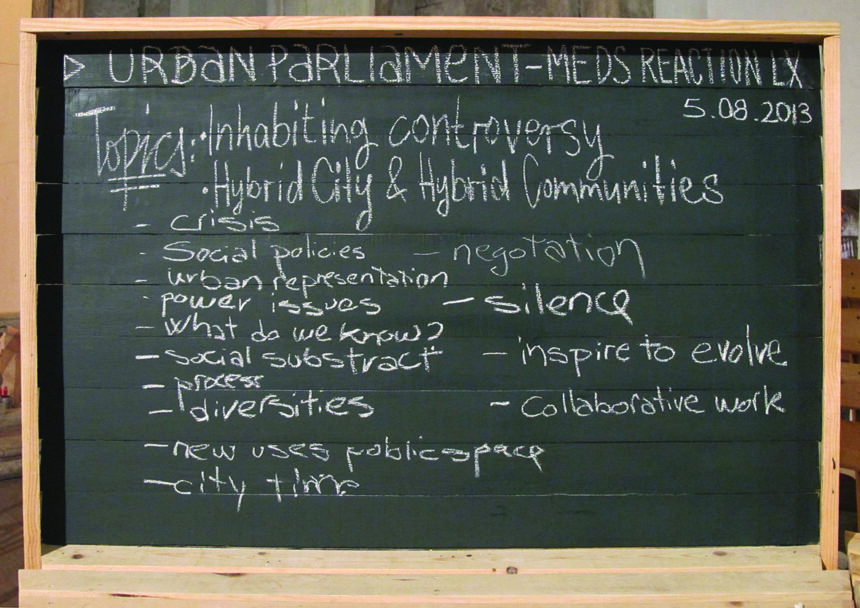
Urban beings and roles
Workshop participants: introduce diverse understandings of public space, conflict and design responsibility.
Local communities in Graça: appear as knowledge-holders and everyday users of public space.
Architects and urban designers: are repositioned as mediators rather than heroic creators.
Public authorities: represent regulation, permissions and the power to allow or block uses.
Temporary interventions: act as tools for testing possibilities before making them permanent.
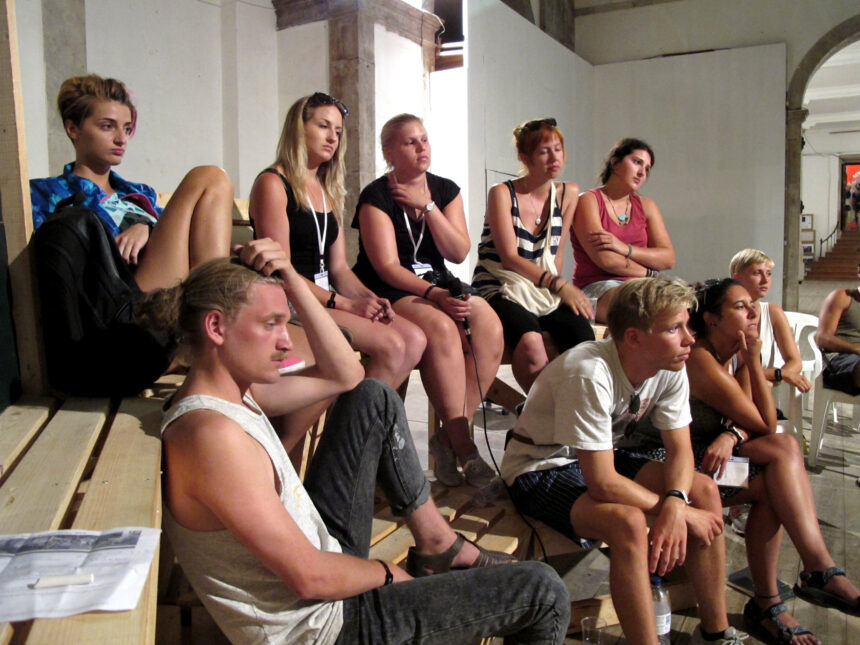
Voices from the Parliaments
Voice of the mediator architect. A participant position that questions the architect as creator and proposes a role between communities, clients and public authorities.
Voice of the activated community. A voice that insists that communities may have forgotten their power to care for and transform their neighbourhoods.
Voice of temporary urbanism. A voice that sees temporary interventions as tests, not as minor or secondary actions.


Rights to introduce
- Right to mediation in urban conflict. Communities, designers and public authorities need spaces where disagreement can be negotiated.
- Right to test temporary uses. Temporary interventions can reveal what a place is able to become.
- Right to community participation in public space. Public space should not be shaped only by experts or institutions.
- Right to dynamic urban programmes. Cities need structures that can change with social life.
Rights or situations to eradicate
- Eradicate the architect-as-hero model. Urban work should not be based on individual authorship alone.
- Eradicate imposed solutions for complex communities. Hybrid cities require multiple readings and negotiated responses.
- Eradicate silence between local groups. Communities need channels to communicate with each other.
- Eradicate the assumption that permanence is always better. Some spaces need reversible, adaptive or temporary actions.
Rights to protect
- Protect appropriation of public space. Everyday uses give meaning to streets and squares.
- Protect community capacity to care for neighbourhoods. Residents are not passive users.
- Protect the public interest. Mediation must connect local wishes with shared responsibilities.
- Protect urban diversity. Hybrid communities require flexible and plural forms of space.
Convening category: Urban controversy, hybrid city and hybrid communities.
Main emergent category: The architect as mediator between communities, public space and public authority.
Secondary categories: Public space, social conflict, temporary interventions, negotiation, collective work, power, community activation.