Adolfo Estalella publica “La apertura del archivo etnográfico” en Anales del Museo Nacional de Antropología
Adolfo Estalella publishes “La apertura del archivo etnográfico” in volume XVI of Anales del Museo Nacional de Antropología, edited by the Spanish Ministry of Culture.
The article asks how anthropological knowledge could be radically opened. Not only through open access —making texts, data or materials available— but in a deeper sense: by transforming the architectures that organise knowledge, who is allowed to produce it, where it is discussed and which material forms make it possible for other kinds of expertise to enter the conversation.
Within this framework, the Universal Declaration of Urban Rights plays a central role. Estalella presents it as one of the projects developed by Zuloark since early 2011, with a clear aim: to turn the urban into an object of learning, debate and experimentation. The Declaration begins as an online audiovisual archive, made up of short interviews in which urban planners, architects, neighbours, citizens and other agents respond to three questions: which urban right should be defended, which should be abolished and which should be claimed.
Estalella’s reading is especially relevant because he understands this archive not as a simple accumulation of videos, but as a free culture practice and as a way of questioning the conventional expertise of urbanism. The Declaration suggests that the design of the city does not belong only to those with technical or institutional legitimacy, but also to those who live, use, care for, narrate and transform urban spaces.
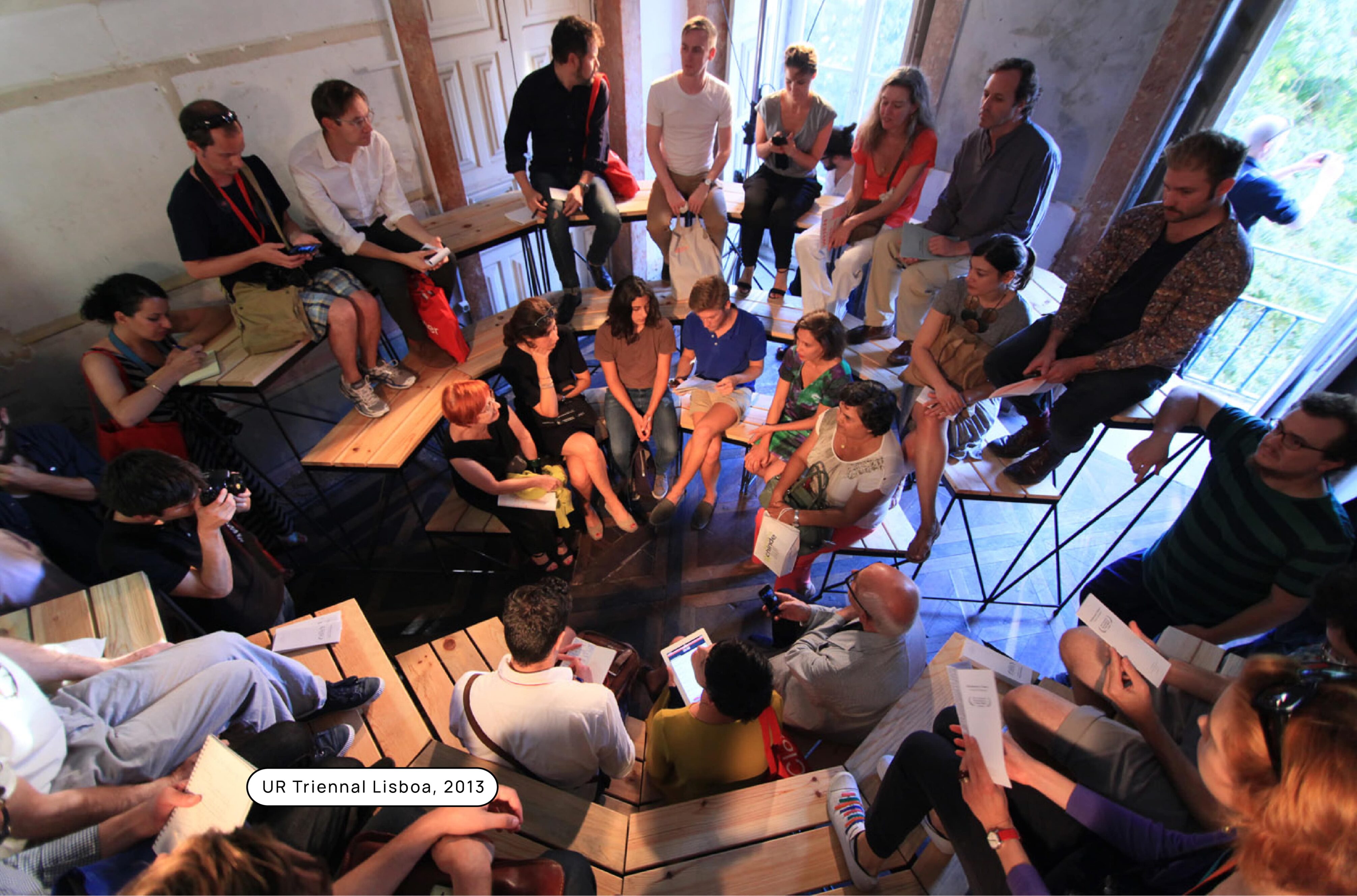
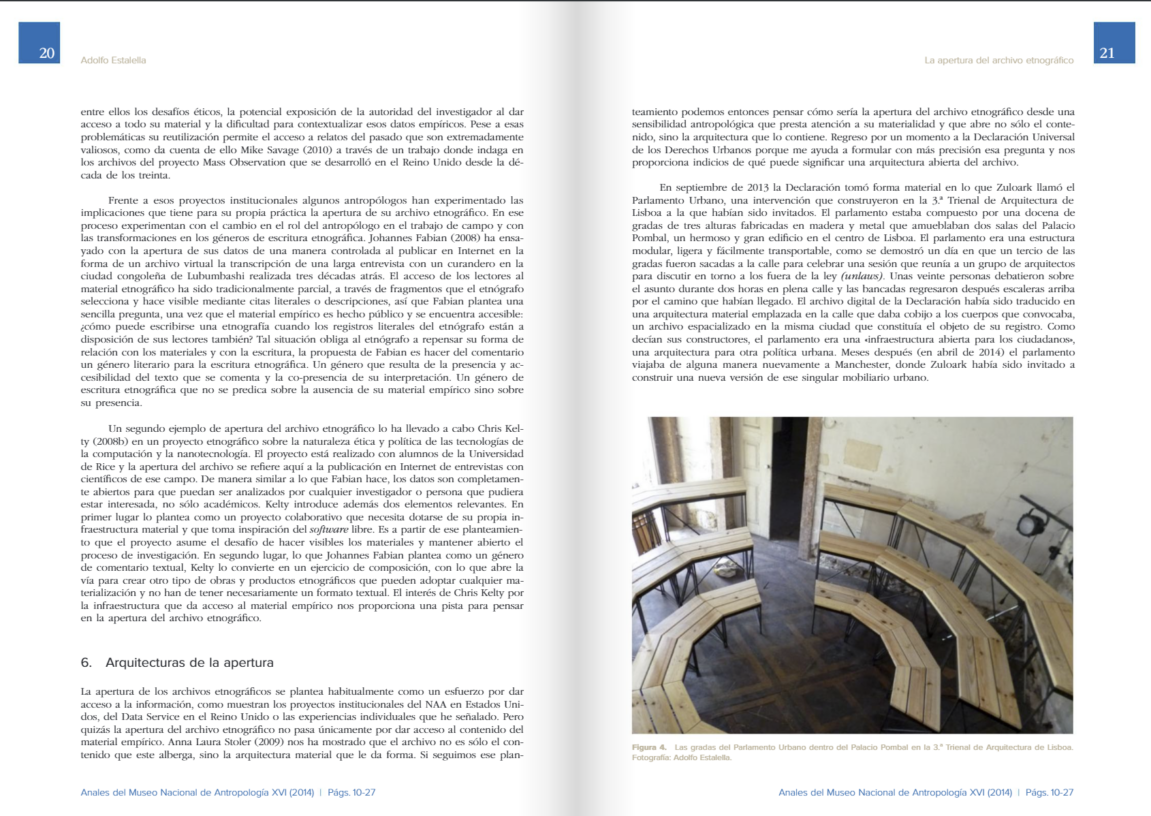
The article goes further by analysing the Urban Parliament built by Zuloark at the 3rd Lisbon Architecture Triennale. There, the Declaration is no longer only a digital repository: it takes shape as a material architecture, a set of modular, lightweight and transportable stands that host public discussion sessions. The archive becomes spatial, becomes furniture, moves through the city and gathers bodies around a shared question: which rights do we need in order to inhabit the city?
This is the strongest proposal of the text: opening an archive is not only about allowing people to access its contents. Opening an archive can also mean building an infrastructure through which others can speak, think, discuss and produce knowledge. In Estalella’s argument, the Urban Parliament works as an infrastructural translation of the archive/declaration: it does not simply represent the archive, it activates it.
From Urban Rights, this publication allows us to understand the Declaration as more than an urban project or a collective research process. It places it as a critical tool for imagining other politics of knowledge: an open architecture where the city becomes an object of experimentation, where urban rights are written collectively and where the archive stops merely preserving what has already happened and begins to produce new forms of citizenship.