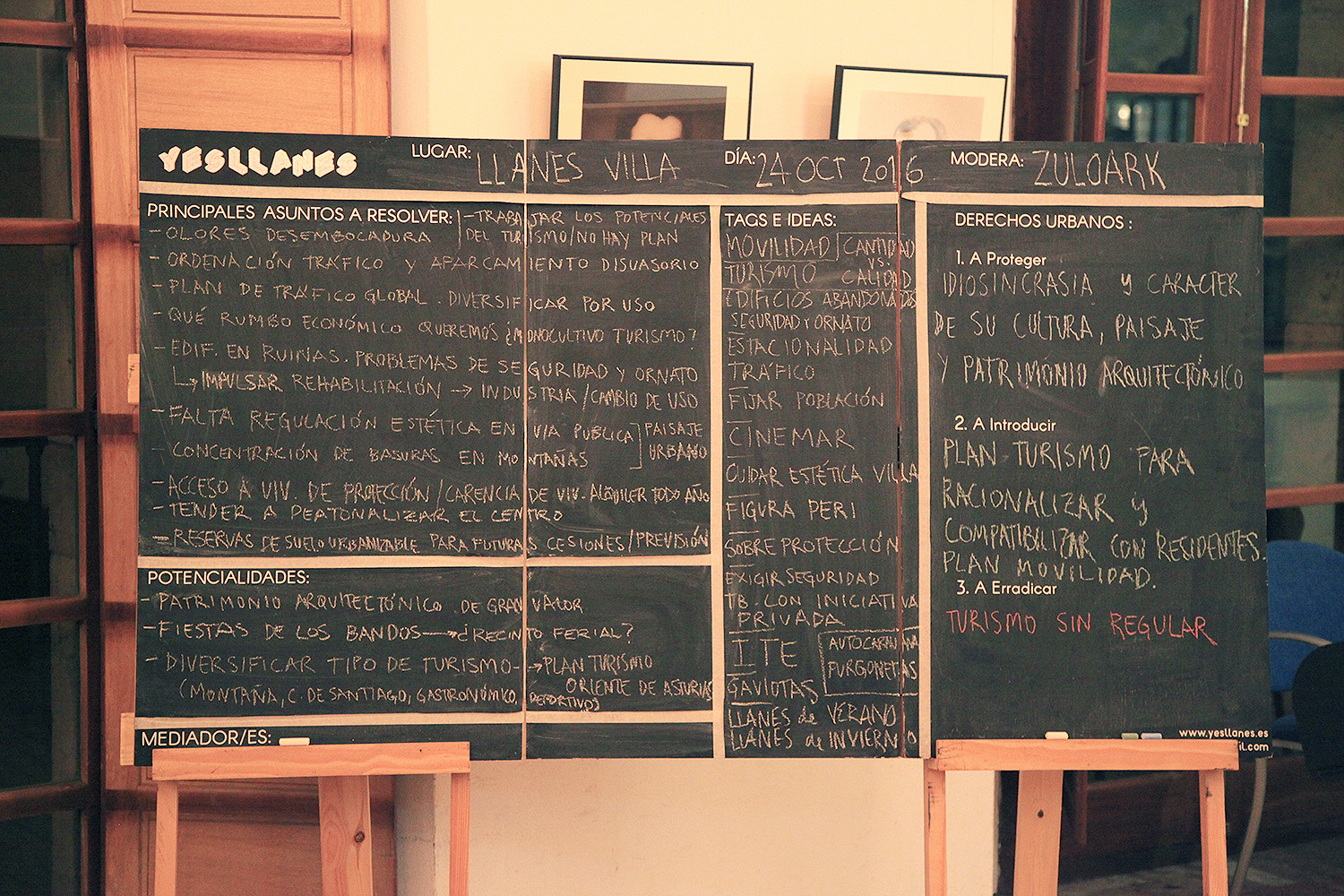
Villa de Llanes parliament
Meeting held at: Casa de la Cultura de Llanes, 24 October 2016, 19:30 h
Participants: 22
The final meeting of the process was held in Villa de Llanes, the municipal capital and an urban centre with a social and economic reality that differs significantly from many of its villages. However, many of the concerns raised connect with issues shared across the whole territory: how to manage the weight of tourism, how to organise mobility, and how to think about an economic model that does not depend on a single activity.
In the town, tourism emerges as a central issue. It is not understood only as a source of economic activity, but as a phenomenon that shapes everyday life: traffic, congestion, the use of public space, pressure on services, and the relationship between those who live in Llanes all year round and those who visit it at certain times.
One of the main demands is the need for a traffic plan that clearly addresses congestion problems. The conversation also points to the need to complete pedestrianisation and organise peripheral parking areas, so that the town centre can gain urban quality without simply displacing the problem to other surrounding areas.
These measures, however, are seen as insufficient unless they form part of a broader strategy. The town needs an integrated tourism project, but that project cannot be limited to the urban centre: it should be designed for the municipality as a whole, recognising the interdependencies between the capital, the villages, the coast, the inland areas, services, commerce, housing and mobility.
The underlying issue goes beyond tourism. The meeting raised the need to open a debate on long-term economic development: what Llanes wants to live from in the future, what types of employment should be promoted, and how the benefits of economic activity can be distributed more widely among more people and more areas of the municipality.
The proposal that emerges is to move towards a more diversified economy, supported by the three productive sectors, capable of reducing excessive dependencies and generating broader returns for citizens. The point is not only to organise the tourist season, but to think about a more balanced municipal model, with employment, mobility and economic activity distributed in a fairer and more sustainable way.
Key ideas
Situation: Villa de Llanes concentrates specific urban challenges, especially traffic, tourism pressure and the use of public space.
Tension: Tourism sustains part of the economy, but it also generates congestion, dependency and imbalances if it is not managed through a municipal-wide vision.
Learning: Mobility solutions — traffic management, pedestrianisation and parking — need to be connected to a broader economic and territorial strategy.