Project for the revitalization of Cuesta de Moyano as an outdoor cultural reading space for Madrid promoted by the Directorate General of Libraries, Archives and Museums within the Department of Culture of the Madrid City Council and a co-learning and co-design process between citizen communities and Administration.
View of the Cuesta de Moyano, in Madrid | Photography by ZuloarkThe Cuesta de Moyano is a pedestrian street in the city of Madrid where second-hand books, maps and posters are sold in picturesque wooden stalls. Inaugurated in 1919 and regulated as a commercial space since 1925, Calle Claudio Moyano or Cuesta de Moyano has become one of the most important and peculiar streets in the capital, both in terms of the number of books and the idiosyncrasy of the stalls that make up the Permanent Book Fair of Madrid. However, we believe that this space transcends its own geographical limits and that its influence extends both to the surrounding area and to the world of books and reading in the city, representing a potential space of reference for urban and cultural change.
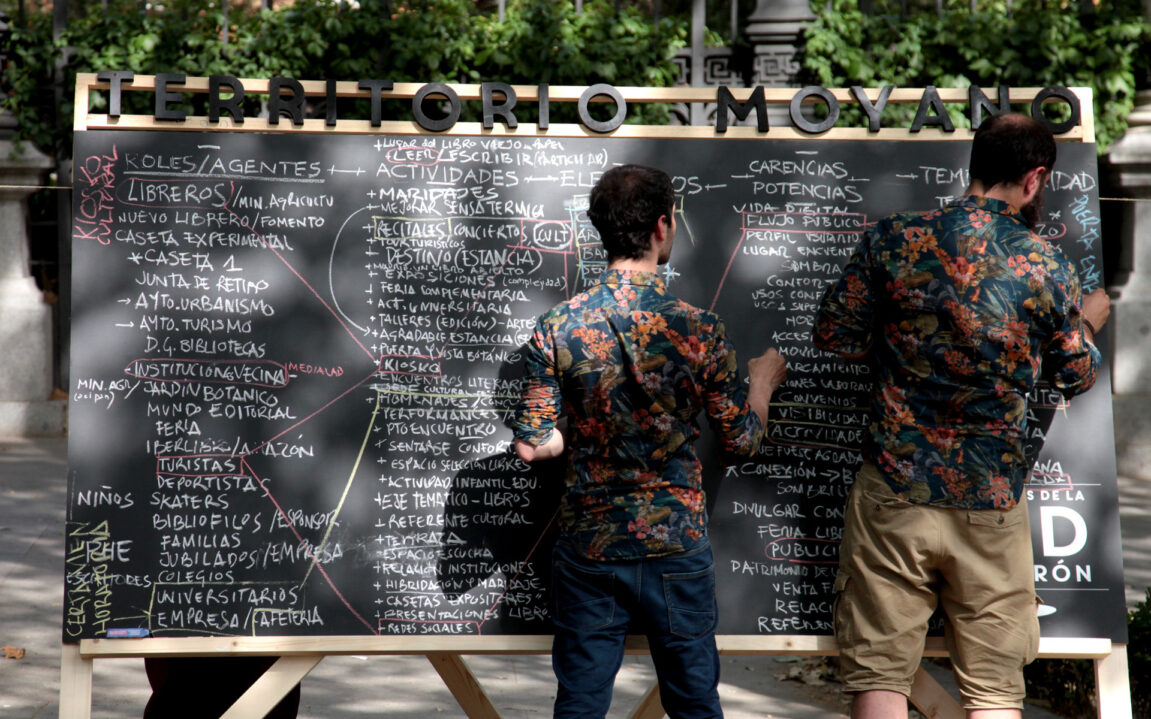
Open workshop identifying opportunities for Cuesta de Moyano | Photography by ZuloarkTerritorio Moyano is being developed in four phases of work, starting in March 2016: making the project known and visible, collaboratively building a catalogue of futures for Moyano, developing prototypes of action that activate the space and planning a final dossier that compiles all that has been learned and allows for easy subsequent implementation.
Neighbors and daily visitors participating in the workshops | Photography by Zuloark
Catalogue of futures for Moyano
On 9th and 10th June, different collaborative meetings were held in the Cuesta de Moyano to draw up a catalogue of possible futures. The proposals in this catalogue discuss three main themes: ‘Public space and cultural activity’, ‘Models of governance and management’ and ‘Identity, communication and visibility’. These were debated in working groups with agents of the Boquerón Network, an open community of agents working on the Cuesta de Moyano.
Meeting in front of a book stall | Photography by Zuloark
The transversal proposal for the coordination of the entire Cuesta pointed to a new cultural and urban institution born from the Madrid City Council: Territorio Moyano as a mixed body capable of coordinating not only the structural reforms that the street needs, but also the management and governance protocols that can represent a true innovative and sustainable urban prototype for the City of Madrid.
Mapping ideas after the open discussions | Photography by Zuloark
Bookseller’s stories
‘Historias de libreros’ (Bookseller’s stories) was born as a project to make the community of Territorio Moyano more visible. It highlights the identity of the 30 booksellers of Moyano, protagonists of almost 100 years of history, of stories and experiences reflected in faces that we believe have a very high communication potential. At the same time, it highlights the real data hidden on the shelves of La Cuesta: it is the largest bookshop in Madrid, with more than 100,000 volumes inside (rarities, unique jewels, first editions…), not to mention the warehouses that the Moyano booksellers own.
Photoreportage of the Moyano booksellers | Photography by Zuloark
Moyano Tells
‘Moyano cuenta’ (Moyano tells) is the third visibility project. It consists of a collective account of the history and reality of the Cuesta de Moyano built from more than 100 stories of anonymous people related to anecdotes or memories lived on the stage of the Cuesta. With this project, the city’s identity is once again valued in a participatory way, and the vital story is played with as literary material that is told and read.
Interviews held during the project on site | Photography by Zuloark
Moyano Rights
‘Moyano cuenta’ (Moyano tells) is the third visibility project. It consists of a collective account of the history and reality of the Cuesta de Moyano built from more than 100 stories of anonymous people related to anecdotes or memories lived on the stage of the Cuesta. With this project, the city’s identity is once again valued in a participatory way, and the vital story is played with as literary material that is told and read.
Open air celebrations in Cuesta de Moyano | Photography by Zuloark
Presentations “al aire libro”: The Last Moyano
One of the experiences of reading dynamisation that have been prototyped are the “open-air book presentations”, a revision of the classic commercial format, enhancing its cultural character in a more playful way, as well as the possibilities that arise in collective experiences in the public space.
Presentation “The Last Moyano” with Jesús Carrasco | Photography by Zuloark
The first experience, co-produced with the collective ‘Hostia un libro’ (HUL), took place on 10 June under the name of “The Last Moyano”, with the writer Jesús Carrasco in a presentation format halfway between a radio interview and a western. This experience was recorded, documented and archived in El Estado Mental in the form of a podcast, serving to test activities and infrastructures that could give continuity to cultural programmes for the promotion of reading in La Cuesta.
Celebrating books | Photography by ZuloarkBookseller in front of his stall on Cuesta de Moyano | Photography by Zuloark
Territorio Moyano is a beta project, rethinking a historic public space in Madrid. It has activated a user community for Cuesta de Moyano, named La Red Boquerón, as a learning and decision-making space to define how a public street dedicated to books, reading, and culture can meet contemporary challenges through a new urbanism model to be built.
La Red Boquerón is a community of affections, interests, and experiences; it’s a way of making the city. The name Boquerón comes from an anecdote by Ramón Gómez de la Serna, who humorously called the Moyano Book Fair the “Boquerón Fair” around 1925. Currently, about 70 people actively participate in La Red Boquerón: active stall booksellers, the Madrid public administration, notable neighbors from nearby public and cultural institutions, and agents from the book and reading sectors in Madrid.
Innovation no longer happens only in laboratories or business clusters like Silicon Valley or Palo Alto garages; innovation and social change emerge on the streets. Territorio Moyano represents innovation in two areas:
*It’s a hybrid city experiment that rethinks a way to produce and promote culture from public space, connected with history and the future, making local economies sustainable.
*It’s an internal municipal experiment, leveraging existing skills and experiences within the public machinery to strengthen communication and network among different Administration areas for the development of a joint project, generating learning in the process itself.
Jacobo Cayetano is a stage designer with a degree from the Real Escuela Superior de Arte Dramático de Madrid (RESAD). His work after graduating from RESAD has varied so much that he ended up decajanegrizing scenography and now revolves around research and artistic/urban practice, designing and devising spaces of possibility.